CM Punjab Solar Panel Scheme Phase 2 (2026)
CM Punjab Solar Panel Scheme Phase 2 (2026): Complete Registration Guide, 8800 SMS Method & Eligibility
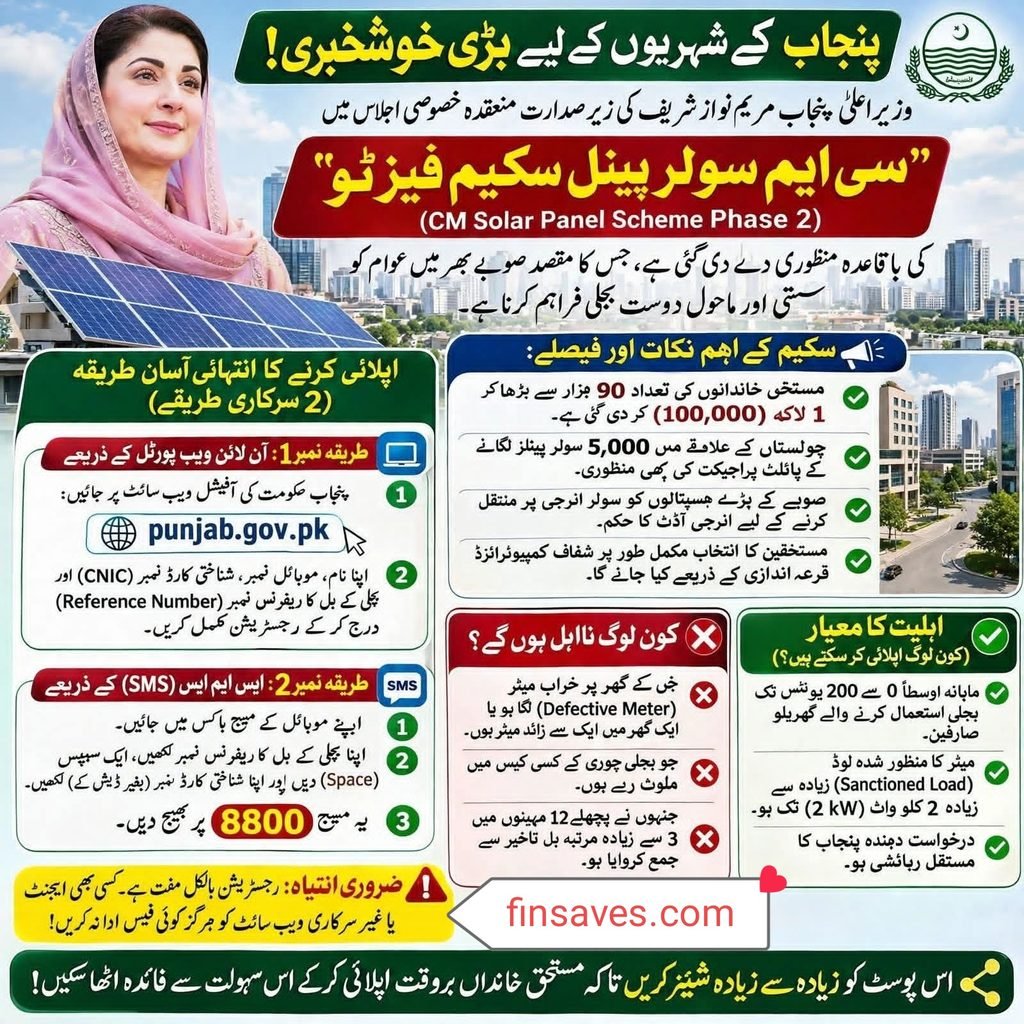
Rising electricity tariffs across Pakistan have made monthly utility bills one of the heaviest financial burdens for low- and middle-income households. Addressing this challenge head-on, Chief Minister Punjab Maryam Nawaz Sharif chaired a special high-level meeting to formally approve the CM Solar Panel Scheme Phase 2. Designed to deliver affordable, eco-friendly electricity across the province, this expanded initiative raises the beneficiary quota to 100,000 deserving families, introduces a dedicated solar pilot project for Cholistan, and initiates an energy audit to transition Punjab’s major communal hospitals to solar power.
Whether you are a domestic consumer looking to cut your monthly WAPDA/DISCO bill or a resident verifying your qualification status, this guide covers every official requirement, disqualification rule, and step-by-step registration method for Phase 2.
Key Highlights & Official Decisions of Phase 2
The Punjab administration has broadened the scope of the provincial solarization drive to maximize impact in both urban centers and underserved remote areas. Under the newly approved Phase 2 framework, the administration has finalized four core directives:
- Expanded Beneficiary Quota: The target number of deserving households receiving solar systems has been increased from 90,000 to 100,000 families across Punjab.
- Cholistan Solar Pilot Project: A dedicated pilot project has been approved to install 5,000 solar panels specifically for residents of the Cholistan region, addressing off-grid energy needs in desert communities.
- Solarization of Major Hospitals: The Chief Minister has ordered a comprehensive energy audit to shift major government hospitals across the province onto solar energy, reducing communal healthcare operational costs.
- Transparent Computerized Balloting: To eliminate political interference or favoritism, all beneficiaries will be selected exclusively through a fully transparent computerized balloting (qurandazi) framework.
CM Solar Panel Scheme Phase 2 at a Glance
| Program Feature | Official Phase 2 Details |
|---|---|
| Program Name | CM Solar Panel Scheme Phase 2 |
| Approved By | Chief Minister Punjab Maryam Nawaz Sharif |
| Total Household Target | 100,000 Deserving Families (Increased from 90,000) |
| Special Regional Quota | 5,000 Solar Panels (Cholistan Pilot Project) |
| Institutional Focus | Energy Audit for Major Provincial Hospitals |
| Eligible Consumption | 0 to 200 Units per Month (Average) |
| Max Sanctioned Load | Up to 2 kW |
| Official Registration Channels | punjab.gov.pk (Online) & 8800 (SMS) |
| Registration Fee | 100% Free (Zero Agent or Processing Fees) |
| Selection Mechanism | Transparent Computerized Balloting |
|
Eligibility Criteria: Who Can Apply?
As the CM Solar Panel Scheme Phase 2 is strictly targeted at low-consumption domestic households, the Punjab Information Technology Board (PITB) and local power distribution companies (DISCOs such as LESCO, MEPCO, FESCO, GEPCO, and IESCO) automatically cross-verify every applicant’s record.
To qualify for the computerized ballot, you must meet all three mandatory conditions:
- Monthly Electricity Usage: You must be a domestic consumer with an average monthly electricity consumption between 0 and 200 units.
- Sanctioned Load Limit: Your electricity meter’s sanctioned load must not exceed 2 kilowatts (2 kW).
- Provincial Residency: The applicant must be a permanent resident of Punjab holding a valid CNIC.
Disqualification Rules: Who Is Not Eligible?
Even if your monthly electricity bill falls under 200 units, your application will be automatically rejected during DISCO verification if you fall under any of the following exclusion categories:
- Defective or Multiple Meters: Households with a defective electricity meter or more than one meter installed at the identical residence are disqualified.
- History of Electricity Theft: Any consumer who has ever been involved in an electricity theft (kunda/tampering) case is permanently ineligible.
- Late Bill Payments: Applicants who have paid their electricity bills late more than 3 times within the last 12 months will not qualify for the scheme.
How to Apply for CM Solar Panel Scheme Phase 2 (2 Official Methods)
The Government of Punjab has streamlined the registration method into two completely at no charge, official channels so that citizens both with and without internet access can apply effortlessly.
Method 1: Online Registration via Web Portal
If you have a smartphone or computer with internet access, applying online is straightforward:
- Visit the official Government of Punjab Portal (or the dedicated CM Solar Scheme Portal once the Phase 2 registration tab goes live).
- Navigate to the CM Solar Panel Scheme registration form.
- Enter your Full Name, Active Mobile Number, 13-digit CNIC Number, and your 14-digit Electricity Bill Reference Number.
- Review your details carefully against your latest electricity bill and submit your application to entire registration.
Method 2: Offline Registration via 8800 SMS
For citizens without reliable internet access, the state provides a quick SMS registration service:
- Accessible the Messages (SMS) app on your mobile phone.
- Type your Electricity Bill Reference Number, attach a single Space, and then type your CNIC Number (without dashes).
- Example format:
12345678901234 3520212345678
- Send this message to the official shortcode 8800.
Important Fraud Warning: Registration for the CM Solar Panel Scheme is 100% free. Do not pay any fee to any agent, middleman, or unofficial online platform claiming to guarantee your selection in the computerized draw.
For readers managing tight household budgets alongside rising utility expenses, exploring verified smart savings and financial management resources can assist you stretch your monthly income further while waiting for balloting results.
Comparison: Online Portal vs. 8800 SMS Registration
Choosing between the two official registration methods depends on your access to the internet and preference for tracking your application.
| Feature | Online Web Portal (punjab.gov.pk) | SMS Method (8800) |
|---|---|---|
| Internet Required | Yes (Smartphone or PC) | No (Works on any basic mobile phone) |
| Information Needed | Name, Mobile No., CNIC, Bill Reference No. | Bill Reference No. + Space + CNIC (No dashes) |
| Processing Cost | Free | Free (Standard network SMS charges apply) |
| Best For | Users who wish dashboard status tracking | Rural residents & quick offline registration |
| Selection Priority | Equal (Same computerized ballot pool) | Equal (Same computerized ballot pool) |
|
Phase 2 vs. Commercial Net-Metered Solar Systems
It is as well key to distinguish between this administration relief program and personal commercial solar installations regulated by the National Electric Power Regulatory Authority (NEPRA). While a private 5kW to 10kW net-metered structure is built for high-consumption homes (500+ units) running air conditioners and exporting surplus units back to the grid, the CM Solar Panel Scheme is strictly a social safety net for 0–200 unit households. It is engineered to offset essential daytime loads—such as ceiling fans and LED lights—so low-income families can drastically cut their monthly bills.
If your household consumes more than 200 units and you are looking for ways to offset higher utility costs, you can browse practical online earning and utility guides to explore supplementary income streams and cost-cutting strategies.
Frequently Asked Questions (FAQs)
1. What is the official SMS code for the CM Punjab Solar Panel Scheme Phase 2?
The only official SMS shortcode is 8800. Deliver your electricity bill reference number, a space, and your 13-digit CNIC number (without dashes) to 8800.
2. How many families will advantage from Phase 2?
Chief Minister Maryam Nawaz Sharif has increased the target from 90,000 to 100,000 deserving families across Punjab, in addition to a 5,000-panel pilot project for Cholistan.
3. Can I apply if my electricity bill is 250 units per month?
No. Eligibility is strictly limited to domestic consumers whose average monthly consumption is between 0 and 200 units with a sanctioned load of up to 2 kW.
4. What happens if I paid my electricity bill late twice latest twelve months?
You are still eligible. Disqualification only applies to consumers who have paid their bills late more than 3 times in the past 12 months.
5. Is there any registration fee or agent commission?
No. Registration via punjab.gov.pk and 8800 is completely complimentary. Not ever distribute your personal details or pay finances to unofficial websites or agents.
6. How will winners be selected?
Beneficiaries will be chosen through a completely transparent computerized balloting method after DISCOs verify applicant eligibility.
Conclusion
The approval of the CM Solar Panel Scheme Phase 2 marks a major expansion in Punjab’s clean energy and public relief strategy. By raising the beneficiary cap to 100,000 households, extending 5,000 solar panels to Cholistan, and initiating energy audits for major communal hospitals, the provincial authority is tackling both household inflation and public-sector energy deficits simultaneously. Eligible residents using 0 to 200 units per period of weeks should keep their CNIC and electricity bill reference number ready, maintain a clean payment record, and apply strictly through punjab.gov.pk or SMS 8800.
Analysis
- Targeted Relief Over Blanket Subsidies: Rather than offering unsustainable cash subsidies on grid electricity, the Punjab state is investing in decentralized solar hardware for the lowest-consumption tier (0–200 units), which provides multi-year bill relief.
- Strict Compliance Filtering: By disqualifying defective meters, multi-meter homes, electricity thieves, and habitual late payers (>3 late bills in 12 months), the scheme actively incentivizes bill discipline and reduces non-technical losses for DISCOs.
- Geographic & Institutional Expansion: Adding a 5,000-panel pilot for Cholistan directly addresses rural energy poverty, while auditing major hospitals for solar conversion signals a long-term shift toward lowering provincial healthcare overhead.
- Digital Accessibility: Offering both a web portal and an offline 8800 SMS channel removes the digital divide, ensuring low-income families without smartphones or internet access are not excluded from the ballot.
Opinion
From a policy and digital-governance standpoint, CM Solar Panel Scheme Phase 2 is a well-structured, high-impact intervention, provided execution matches its structure. Raising the quota to 100,000 families and relying on automated DISCO verification alongside computerized balloting are the exact guardrails needed to maintain public trust.
However, the authentic test of Phase 2 will lie in post-balloting installation speed and after-sales maintenance. Low-income households cannot afford out-of-pocket inverter repairs or wiring replacements. If the Punjab Energy Department pairs this 100,000-unit rollout with clear vendor warranties and a responsive helpline for hardware faults, Phase 2 can serve as a blueprint for sustainable energy relief across Pakistan. For eligible citizens right now, the smartest move is simple: verify your meter status, pay your bills on moment, and register exclusively through official government channels.
About the Writer: Majid Farooq
Educationist & Web Tool DeveloperMajid Farooq is an experienced English educator, academic content specialist, and digital assessment developer holding M.A. English, M.Ed., and B.Ed. degrees. With over a decade of teaching and college lecturing experience, he specializes in creating SLO-based study resources, interactive educational web tools, and step-by-step official documentation guides for students, teachers, and professionals across Pakistan. Through FinSaves.com, he is dedicated to delivering accurate, verified, and easy-to-follow educational, health, and public-service guides that empower readers with practical knowledge. Whether breaking down complex board examinations, admission procedures, or regulatory portals, his work focuses on clarity, authenticity, and real-world utility.