BISE Rawalpindi E-Marking System 2027
BISE Rawalpindi E-Marking System 2027: Complete Guide to On-Screen Marking for Matric Exams
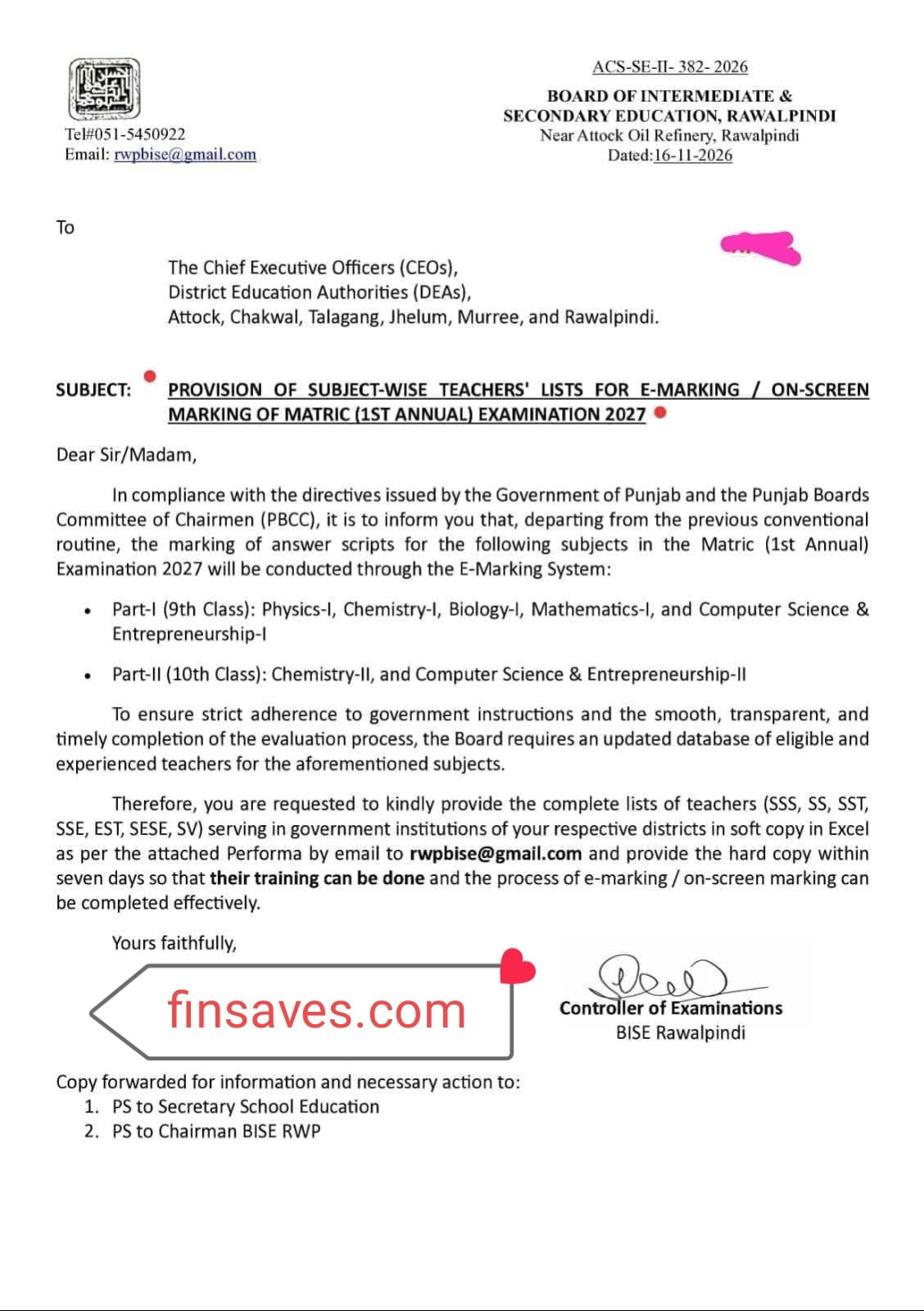
The Board of Intermediate and Secondary Education (BISE) Rawalpindi has officially initiated the operational rollout of the E-Marking (On-Screen Marking) System for the upcoming Matric (1st Annual) Examination 2027. Following directives from the Government of Punjab and the Punjab Boards Committee of Chairmen (PBCC), this structural reform replaces traditional manual paper-bundle checking with high-speed digital scanning and centralized on-screen evaluation.
In a formal notification issued on November 16, 2026 (Ref: ACS-SE-II-382-2026), the Controller of Examinations directed Chief Executive Officers (CEOs) of District Education Authorities (DEAs) across Attock, Chakwal, Talagang, Jhelum, Murree, and Rawalpindi to submit subject-wise lists of eligible state school teachers within seven days for mandatory digital training.
For students preparing under the 9th, 10th, 11th, and 12th Class Official Smart Syllabus ALP (2026–2027) and educators serving in public institutions, understanding how on-screen marking operates is essential before the 2027 exam cycle begins.
Official Notification Overview: Key Details & Deadlines
The November 16, 2026 directive marks the transition from pilot testing to full-scale Matriculation implementation in the Rawalpindi Division. Rather than transporting physical bundles of reply scripts to centralized marking camps, BISE Rawalpindi will scan student solution booklets (E-Sheets) and assign them digitally to trained examiners.
| Parameter | Official Details |
|---|---|
| Issuing Authority | Board of Intermediate & Secondary Education (BISE), Rawalpindi |
|
| Reference Number | ACS-SE-II-382-2026
|
| Notification Date | November 16, 2026
|
| Target Examination | Matric (SSC) 1st Annual Examination 2027
|
| Covered Districts | Attock, Chakwal, Talagang, Jhelum, Murree, and Rawalpindi
|
| Eligible Teaching Cadres | SSS, SS, SST, SSE, EST, SESE, and SV (Government Institutions)
|
| Data Submission Deadline | Within 7 days of notification (Soft copy in Excel via email + Hard copy)
|
| Official Submission Email | rwpbise@gmail.com
|
Subjects Included in BISE Rawalpindi E-Marking 2027
The PBCC and BISE Rawalpindi have prioritized core science, mathematics, and computing subjects for the earliest phase of Matriculation e-marking. Both Part-I (9th Class) and Part-II (10th Class) candidates appearing in the 1st Annual Examination 2027 will have exact scripts evaluated on-screen:
Part-I (9th Class) E-Marking Subjects
- Physics-I
- Chemistry-I
- Biology-I
- Mathematics-I
- Computer Science & Entrepreneurship-I
Part-II (10th Class) E-Marking Subjects
- Chemistry-II
- Computer Science & Entrepreneurship-II
(Note: While SSC Part-II 1st Annual Examinations across Punjab are scheduled to commence on March 16, 2027, candidates and teachers should verify any subsequent subject additions directly on the BISE Rawalpindi Official E-Services Portal.)
How the On-Screen Marking (OSM) System Works
A common misconception among students and parents is that e-marking means students will type their exams on computers. This is incorrect. Candidates will continue to sit in traditional examination halls and write their answers by hand using pens on specialized printed reply booklets known as E-Sheets.
The end-to-finish digital workflow operates in four structured stages:
- Barcode & QR-Coded Answer Booklets: Each E-Sheet is pre-printed with unique barcodes, QR codes, and designated solution boxes. Candidate attendance and invigilation staff are also verified via QR-code tracking.
- High-Speed Trimming & Scanning: Once the exam concludes, reply booklets are transported to BISE Rawalpindi’s secure scanning hub, where industrial scanners digitize every page into high-resolution images and strip away learner identification details.
- Digital Allocation & On-Screen Grading: Authorized teachers log into a centralized online evaluation dashboard. Examiners view anonymized scanned responses question-by-question on a computer screen and enter marks directly into the digital rubric.
- Automated Tabulation: The software automatically calculates inquiry totals, prevents skipped pages, and flags erratic grading patterns in real duration, eliminating manual addition errors.
Traditional Paper Checking vs. E-Marking System (Comparison)
The shift from physical scripts to on-screen evaluation addresses several long-standing administrative bottlenecks in Punjab’s examination boards.
| Feature / Criteria | Traditional Manual Marking | BISE E-Marking (On-Screen Marking) |
|---|---|---|
| Script Handling | Physical paper bundles transported to marking camps | Digitized high-speed scans accessed via secure cloud dashboard |
| Candidate Anonymity | Fictitious roll numbers stamped manually | Complete digital masking; examiners only see scanned reply zones |
| Calculation Accuracy | Prone to human totaling and posting errors | 100% automated software calculation and total verification |
| Examiner Oversight | Periodic review by Head Examiners | Real-time keystroke logging, pace monitoring, and rubric enforcement |
| Result Compilation Time | Delayed due to physical transit and manual sheet entry | Significantly accelerated through instant database synchronization |
| Physical Security Risks | Risk of lost, damaged, or tampered scripts in transit | Zero physical transit after initial scanning; encrypted backups |
Actionable Guidelines for Teachers & DEAs
To develop the examiner database for Matric 2027, District Education Authorities in all six districts of the Rawalpindi division must compile accurate faculty records.
- Eligible Designations: Subject Specialists (SSS), Senior Subject Specialists (SS), Secondary School Teachers (SST), Secondary School Educators (SSE), Elementary School Teachers (EST), Senior Elementary School Educators (SESE), and Senior Vernacular (SV) teachers currently serving in government schools are eligible.
- Dual Submission Format: School heads and DEAs must submit the prescribed proforma in soft copy (Microsoft Excel) to
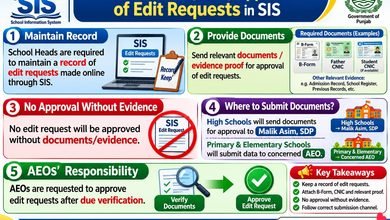
rwpbise@gmail.comalongside a verified hard copy within seven days. Educators needing to verify or update their service records beforehand should consult our Complete Guide to Approval of Edit Requests in SIS Punjab. - Mandatory Training Workshops: Shortlisted teachers will undergo hands-on district-stage training covering dashboard navigation, digital annotation tools, zooming features, and adherence to official PBCC marking rubrics.
Essential E-Sheet Tips for Matric 2027 Students
Because examiners will evaluate scanned images rather than physical paper, students appearing in Physics, Chemistry, Biology, Mathematics, and Computer Science must adjust their exam-hall habits:
- Stay Strictly Within Margins: Scanners crop pages according to pre-set coordinates. Anything written outside the designated response box or margin may be cut off during scanning.
- Protect Barcodes and QR Codes: Never fold, smudge, author over, or staple across the barcodes/QR codes printed on the E-Sheet. Damaged codes delay script indexing.
- Use High-Contrast Ink: Write neatly with a standard blue or black ballpoint/ink pen. Avoid light-colored gel pens, highlighters, or correction fluid (whitener), which can cause glare or obscure text under high-speed scanners.
- Match Question Numbers Carefully: Write each response only in the designated space assigned to that particular question number so the digital cropping application routes your response to the proper subject rubric.
For broader national policy standards on digital examination alignment and grading equivalencies across Pakistani boards, students and educators can review guidelines published by the Inter Boards Coordination Commission (IBCC) and the Punjab School Education Department.
Frequently Asked Questions (FAQs)
1. Will Matric 2027 students take their exams on computers?
No. Students will write their exams manually on paper E-Sheets inside examination centers. Only the checking process by teachers is conducted digitally on computer screens after the sheets are scanned.
2. Which subjects are included in BISE Rawalpindi’s E-Marking for Matric 2027?
For 9th Class (Part-I), Physics, Chemistry, Biology, Mathematics, and Computer Science & Entrepreneurship are included. For 10th Class (Part-II), Chemistry and Computer Science & Entrepreneurship are included.
3. Which districts are covered under this BISE Rawalpindi notification?
The directive applies to all state schools and DEAs across six districts: Rawalpindi, Attock, Chakwal, Talagang, Jhelum, and Murree.
4. How will e-marking affect students’ marks and rechecking?
E-marking eliminates arithmetic totaling mistakes and prevents unchecked pages. As examiners cannot see student identities, grading bias is minimized, leading to fairer and more consistent results.
5. What should teachers do to prepare for on-screen marking?
Eligible authority teachers (SST, SSE, EST, SESE, SS, SSS, SV) should ensure their names are included in their district’s Excel proforma submitted to BISE Rawalpindi and attend the upcoming district-standard OSM training workshops.
Conclusion
The introduction of the E-Marking System for the Matric (1st Annual) Examination 2027 represents a landmark modernization effort by BISE Rawalpindi and the Punjab Boards Committee of Chairmen. By digitizing the evaluation of high-stakes STEM subjects—including Physics, Chemistry, Biology, Mathematics, and Computer Science—the board is directly addressing decades-old concerns surrounding calculation errors, script mishandling, and outcome delays. Timely submission of educator databases by DEAs and proactive preparation by students regarding E-Sheet formatting will ensure a seamless transition into Punjab’s digital assessment era.
Analysis
- Strategic Rollout: Rather than overhauling every subject simultaneously, PBCC and BISE Rawalpindi have targeted objective-heavy, rubric-driven STEM subjects (5 subjects in 9th Class and 2 in 10th Class) where standardized marking schemes yield the highest accuracy gains.
- Administrative Accountability: Requiring both Excel soft copies and verified tough copies within a strict 7-day window signals that BISE Rawalpindi is prioritizing early faculty onboarding and hands-on computer literacy training ahead of the March 2027 exam cycle.
- Shift in Student Exam Technique: Academic performance in 2027 will no longer rely solely on subject knowledge; spatial discipline—staying within margins, avoiding whitener, and protecting QR codes—now directly impacts how clearly an examiner sees a learner’s job.
Opinion
BISE Rawalpindi’s move toward On-Screen Marking is a long-overdue and overwhelmingly positive reform for Pakistan’s secondary education ecosystem. For years, bright students have suffered from manual totaling errors and rushed camp-based paper checking, while honest teachers faced immense logistical strain. Digitizing the evaluation pipeline brings Punjab’s examination standards closer to international boards like Cambridge Assessment. Nonetheless, the success of this initiative hinges entirely on the standard of the upcoming educator training workshops and reliable high-speed scanning infrastructure. If BISE Rawalpindi executes faculty training thoroughly over the next three months, this model will set the gold standard for every other BISE across Punjab.
For a visual walkthrough of how E-Sheets and on-screen marking labor for the 2027 Punjab Board exams, watch E Marking Punjab Board Exams 2027 Computerized Checking, which explains the fresh QR-coded reply booklet rules and digital grading procedure for students and teachers.
اس سال نہم کلاس کے فزکس کیمسٹری بائیو ریاضی اور کمپیوٹر سائنس کے پیپر ای شیٹ پر لیے جائیں گے جبکہ کلاس دہم کے کیمسٹری اور کمپیوٹر سائنس کے .
About the Writer: Majid Farooq
Educationist & Web Tool DeveloperMajid Farooq is an experienced English educator, academic content specialist, and digital assessment developer holding M.A. English, M.Ed., and B.Ed. degrees. With over a decade of teaching and college lecturing experience, he specializes in creating SLO-based study resources, interactive educational web tools, and step-by-step official documentation guides for students, teachers, and professionals across Pakistan. Through FinSaves.com, he is dedicated to delivering accurate, verified, and easy-to-follow educational, health, and public-service guides that empower readers with practical knowledge. Whether breaking down complex board examinations, admission procedures, or regulatory portals, his work focuses on clarity, authenticity, and real-world utility.
Physics and mathematics