Complete Guide to Approval of Edit Requests in SIS Punjab
Complete Guide to Approval of Edit Requests in SIS Punjab: Rules, Required Documents, and Submission Channels
Maintaining accurate, tamper-proof digital records across thousands of open institutions is one of the biggest operational challenges for the School Education Department (SED), Government of Punjab. Whether it is correcting a student’s spelling error, updating a father’s Computerized National Identity Card (CNIC) number, or rectifying an admission date, the School Information System (SIS) serves as the central backbone for real-period educational governance.
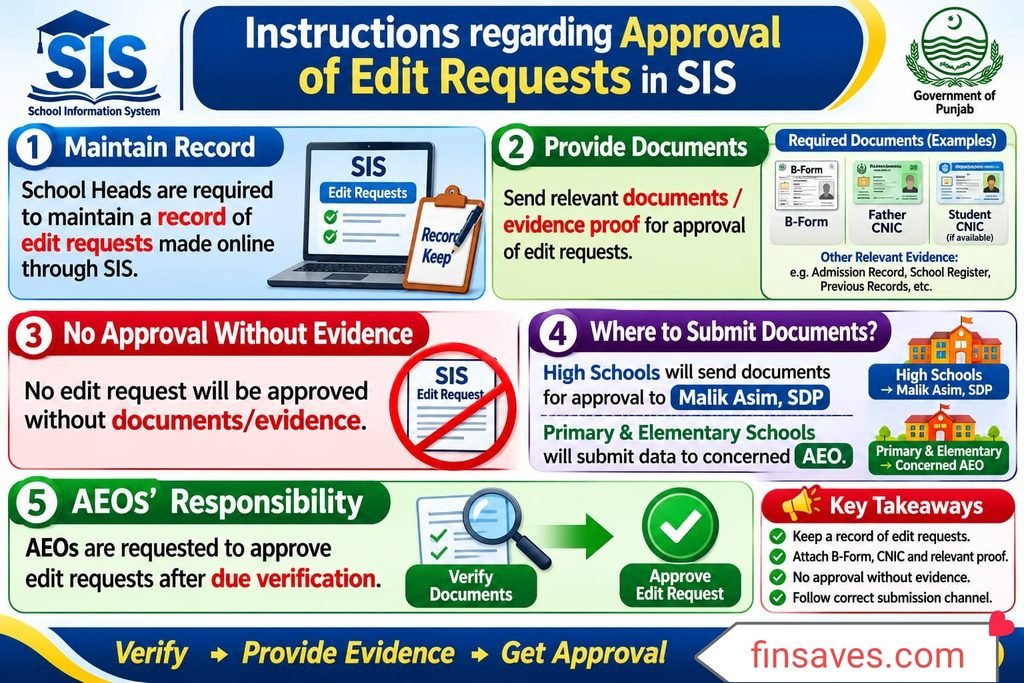
To prevent unauthorized modifications, ghost enrollments, and data manipulation, the department enforces strict Standard Operating Procedures (SOPs) for approving online edit requests. Under the directive “Verify → Provide Evidence → Get Approval for Accurate and Reliable SIS Data,” institution heads and Assistant Education Officers (AEOs) must follow a five-step verification workflow before any profile modification goes live.
Understanding the SIS Edit Request Framework in Punjab
Developed by the Punjab Information Technology Board (PITB), the School Information System tracks student enrollment, teacher transfers, attendance, and institution facilities across Punjab. Because pupil records on SIS are directly cross-checked against national databases—and frequently linked to authority scholarships, board registrations, and stipends—even a minor typographical mistake can block a learner’s academic progression.
When a school head initiates a data correction online through the SIS tablet app or web portal, the system flags the entry as an Edit Request. Unlike routine attendance updates, edit requests do not take effect immediately. Instead, they enter a mandatory verification pipeline designed to ensure accountability at both the institution and administrative levels.
The 5 Mandatory Instructions for SIS Edit Request Approval
According to official departmental guidelines issued for open schools in Punjab, every edit request must adhere to five strict rules:
1. Maintain a Proper Record of Edit Requests
School Heads are strictly required to maintain a physical and digital logbook of all edit requests initiated online through SIS. Simply submitting a request on the SIS tablet is not enough. Keeping a chronological register—complete with the student’s name, SIS tracking ID, date of request, requested adjust, and current approval status—protects the head teacher during Monitoring and Evaluation Assistant (MEA) spot visits and departmental audits.
2. Supply Valid Documents and Supporting Evidence
Every online edit request must be backed by verifiable documentary proof. Verbal assurances from parents or unverified handwritten notes are strictly rejected. School heads must compile evident, legible copies of official records that prove the requested correction matches legal reality.
3. Strictly “No Approval Without Evidence”
The department enforces a zero-tolerance policy: no edit request will be approved without physical or scanned documentary evidence. If an edit request is pushed through the portal without supporting documentation reaching the approving authority, it is subject to immediate rejection.
4. Follow the Designated Submission Channel
Where you send the verification file depends entirely on the administrative tier of your school. Routing documents to the wrong office delays approval and creates administrative bottlenecks:
- High Schools: Must submit their verification documents and edit request files directly to Malik Asim, SDP (System Data Processor / Focal Person).
- Primary & Elementary Schools: Must submit their data and supporting evidence to their concerned Assistant Education Officer (AEO).
5. Due Verification Responsibility of AEOs
Assistant Education Officers (AEOs) serve as the primary gatekeepers for Primary and Elementary academy data. AEOs are explicitly instructed to scrutinize the physical evidence against the online request and approve edit requests only after due verification. Rubber-stamping requests without cross-checking original documents is a violation of departmental compliance standards.
Checklist of Required Documents for SIS Data Correction
To ensure your edit request is approved on the primary attempt, attach the appropriate evidence from the following official checklist:
- Child Registration Certificate (NADRA B-Form): The primary legal document for verifying a student’s exact name, spelling, date of birth, and parentage. You can verify or review registration requirements directly through the NADRA Child Registration Certificate (CRC) Portal.
- Father’s / Guardian’s CNIC: Essential for validating parent identity numbers, resolving duplicate family entries, and linking pupil profiles to verified household records.
- Student’s CNIC / Juvenile Card (if accessible): Mandatory for older students (typically in secondary or higher secondary classes) who have reached the age of 18 or hold a NADRA Juvenile Card.
- School Admission & Withdrawal Register (Dakhil Kharij): Certified copies of the original manual school register showing the entry recorded at the period of admission.
- Previous School Leaving Certificate (SLC): Required when correcting transfer-in dates, previous class records, or enrollment histories.
| Data Field to Edit | Primary Required Evidence | Secondary / Supporting Proof |
|---|---|---|
| Student Name / Spelling | NADRA B-Form (CRC) |
| School Admission Register (Dakhil Kharij)
|
| Date of Birth (DOB) | NADRA B-Form / Birth Certificate
| Previous School Leaving Certificate (SLC)
|
| Father’s Name / CNIC | Father’s Valid NADRA CNIC
| Student’s NADRA B-Form
|
| Student CNIC Number | Student’s Smart Card / Juvenile Card
| NADRA Verification Slip |
| Admission Date / Class | School Admission & Withdrawal Register
| Previous Exam Result Card / SLC
|
Comparison: High Schools vs. Primary & Elementary Schools Submission Workflow
While the core requirement of maintaining logs and attaching NADRA-verified proof applies uniformly across Punjab, the administrative routing differs between institution tiers. Understanding this distinction prevents unnecessary back-and-forth between Markaz and Tehsil/District offices.
| Feature / Parameter | Primary & Elementary Schools | High & Higher Secondary Schools |
|---|---|---|
| Initiating Authority | Head Teacher / School In-Charge |
| Principal / Headmaster / Headmistress
|
| Record Keeping | Mandatory SIS Edit Request Logbook
| Mandatory SIS Edit Request Logbook
|
| Approving / Focal Officer | Concerned AEO (Markaz Level)
| Malik Asim, SDP (Designated Focal Person)
|
| Verification Standard | Physical inspection by AEO before portal approval
| Documentary scrutiny by SDP before portal update
|
| Primary Evidence | B-Form, Father CNIC, Admission Register
| B-Form, Student/Father CNIC, Board/School Record
|
Just as accurate record-keeping and structured verification protect public institutions from compliance failures, maintaining clean, well-documented financial records is equally vital for households and organizations managing budgets, tax filings, and long-term savings—a principle explored in detail across financial planning resources at Finsaves.
Best Practices for School Heads to Avoid Edit Request Rejections
Even legitimate edit requests regularly acquire stuck in pending status due to preventable clerical oversights. Follow these field-tested optimal practices to streamline approvals:
- Cross-Check NADRA Spelling Before Submitting: Ensure the English spelling entered in the SIS tablet matches the NADRA B-Form character-for-character. Even an extra space or misplaced vowel can trigger a mismatch.
- Attest All Supporting Copies: Have the School Head sign and stamp every photocopy (B-Form, Father’s CNIC, and Admission Register extract) to certify that the copy has been verified against the original document.
- Batch Weekly Submissions: Instead of visiting the AEO or SDP office for a single learner record, compile all weekly edit requests into a single indexed folder with a cover sheet listing each learner’s SIS ID.
- Update Local Registers Simultaneously: Once an edit request is approved on SIS, ensure the school’s physical Dakhil Kharij register reflects any officially rectified details (with proper red-ink attestation) so physical and digital records remain 100% synchronized.
- Plan Institutional and Personal Budgets Smartly: Teachers and institution administrators managing personal allowances, GP Fund deductions, or retirement planning can utilize practical financial estimation guides on Finsaves personal finance tools to keep their personal documentation as organized as their institution records.
For broader policy updates, circulars, and digital governance initiatives across the province, educators can additionally consult the official School Education Department Punjab Portal.
Frequently Asked Questions (FAQs)
Can an SIS edit request be approved without a NADRA B-Form or CNIC?
No. Departmental instructions explicitly state that no edit request will be approved without valid documentary evidence. If a pupil does not yet have a NADRA B-Form, parents must obtain one from NADRA before the institution can operation official name or date-of-birth corrections on SIS.
Who approves SIS edit requests for Primary and Elementary schools?
For Primary and Elementary schools, edit requests are verified and approved by the concerned Assistant Education Officer (AEO) after inspecting the physical documents submitted by the school head.
Where should High Schools submit documents for SIS edit request approval?
High Schools must route their supporting documents and verification files directly to Malik Asim, SDP, rather than submitting them through the AEO channel.
What records must a School Head maintain for SIS edit requests?
Academy Heads must maintain a dedicated record (register/file) of all edit requests submitted online via SIS, along with copies of the attached evidence (B-Form, Father’s CNIC, Student CNIC, and Admission Register extracts).
Why does the School Education Department enforce strict verification for SIS edits?
Strict verification ensures data integrity across Punjab’s open schools, prevents fake or duplicate learner entries, and guarantees that learner records remain accurate for board exams, scholarships, and national database synchronization.
Conclusion
The School Information System (SIS) has transformed educational administration in Punjab by replacing fragmented paperwork with real-time digital accountability. However, a digital structure is only as reliable as the data entered into it. By strictly following the five-point directive—maintaining an edit request log, attaching verified NADRA and institution records, respecting the “no evidence, no approval” rule, routing files through the right channel (AEO for Primary/Elementary, Malik Asim SDP for High Schools), and ensuring thorough AEO verification—educators safeguard the accuracy and credibility of every student’s academic identity.
Analysis
The departmental directive on SIS edit request approvals highlights a decisive shift from trust-based data entry to evidence-backed digital governance. Three core operational takeaways stand out:
- Decentralized Execution, Centralized Accountability: While School Heads retain the autonomy to initiate corrections on their SIS tablets, final approval is decoupled from the data-entry point. Separating the requester (School Head) from the verifier (AEO or SDP) eliminates unilateral data tampering.
- Tier-Specific Routing Eliminates Bottlenecks: By dividing verification channels—assigning Primary and Elementary schools to their respective AEOs and directing High Schools to Malik Asim, SDP—the department balances workload across administrative tiers and establishes obvious points of responsibility.
- NADRA as the Single Source of Truth: Prioritizing the NADRA B-Form and CNIC over informal school records aligns educational data with Pakistan’s national identity infrastructure, preventing downstream discrepancies during secondary board registrations and scholarship disbursements.
Opinion
Enforcing a strict “No Approval Without Evidence” policy is not merely bureaucratic red tape—it is an essential safeguard for general education integrity. In the past, lax oversight allowed well-meaning clerical shortcuts—or deliberate enrollment inflation—to corrupt district-level statistics. By mandating physical logbooks at the school level and holding AEOs and SDPs accountable for due verification, the School Education Department ensures that SIS remains a trustworthy decision-making instrument. For institution heads, the smartest approach is proactive compliance: verify parents’ NADRA documents at the time of initial admission so that edit requests become the rare exception rather than a routine administrative burden.
About the Writer: Majid Farooq
Educationist & Web Tool DeveloperMajid Farooq is an experienced English educator, academic content specialist, and digital assessment developer holding M.A. English, M.Ed., and B.Ed. degrees. With over a decade of teaching and college lecturing experience, he specializes in creating SLO-based study resources, interactive educational web tools, and step-by-step official documentation guides for students, teachers, and professionals across Pakistan. Through FinSaves.com, he is dedicated to delivering accurate, verified, and easy-to-follow educational, health, and public-service guides that empower readers with practical knowledge. Whether breaking down complex board examinations, admission procedures, or regulatory portals, his work focuses on clarity, authenticity, and real-world utility.