PECTAA 2-Day AI Training for 25,898 AI Focal Persons
PECTAA 2-Day AI Training for 25,898 AI Focal Persons Under TALEEM Project: Complete Schedule, Guidelines & Implementation Guide
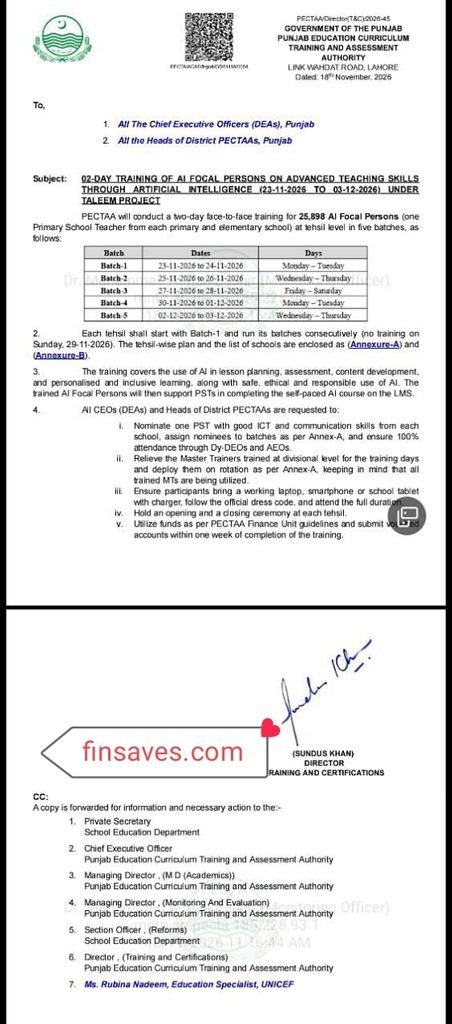
The Punjab Education Curriculum Training and Assessment Authority (PECTAA) has officially launched a massive province-wide capacity-building initiative under the TALEEM Project, targeting 25,898 AI Focal Persons across Punjab. Issued via official directive PECTAA/Director(T&C)/2026-45 on 18th November 2026, this two-day face-to-face workshop is designed to equip one Primary School Teacher (PST) from every primary and elementary institution with advanced pedagogical skills powered by Artificial Intelligence.
Running consecutively in five structured batches from 23rd November 2026 to 3rd December 2026 at the tehsil standard, this training represents a pivotal shift in Punjab’s public education framework. Rather than treating technology as an optional attach-on, PECTAA—in strategic alignment with the School Education Department (SED) and UNICEF—is embedding generative AI directly into daily lesson planning, learner assessment, content creation, and inclusive classroom management.
Official Notification Overview & Key Directives
The directive from the Directorate of Training and Certifications, Link Wahdat Road, Lahore, establishes evident operational parameters for all Chief Executive Officers (District Education Authorities) and Heads of District PECTAAs across Punjab.
- Issuing Authority: Punjab Education Curriculum Training and Assessment Authority (PECTAA), Government of the Punjab
- Notification Reference: PECTAA/Director(T&C)/2026-45 (Tracking ID: PECTAA/ACAD/trgert/O/261118/0354)
- Date of Issuance: 18th November 2026
- Total Target Cohort: 25,898 AI Focal Persons (1 Primary School Teacher per primary/elementary institution)
- Training Venue Level: Tehsil Level across all districts of Punjab
- Training Format: 02-Day Face-to-Face Practical Workshop followed by LMS mentorship
Complete Batch-Wise Training Schedule (23 Nov – 03 Dec 2026)
To ensure smooth logistics and focused hands-on learning without disrupting institution operations across all districts simultaneously, PECTAA has divided the 25,898 nominees into five consecutive two-day batches. Every tehsil will initiate operations with Batch-1 and progress sequentially, observing an official break on Sunday, 29th November 2026.
| Batch Number | Training Dates | Scheduled Days | Operational Notes |
|---|---|---|---|
| Batch-1 | 23-11-2026 to 24-11-2026 | Monday – Tuesday | Opening ceremony at tehsil level; Cohort 1 initiation |
| Batch-2 | 25-11-2026 to 26-11-2026 | Wednesday – Thursday | Consecutive rollout per Annexure-A |
| Batch-3 | 27-11-2026 to 28-11-2026 | Friday – Saturday | Pre-weekend cohort; followed by Sunday break (29-11-2026) |
| Batch-4 | 30-11-2026 to 01-12-2026 | Monday – Tuesday | Post-Sunday resumption across all tehsils |
| Batch-5 | 02-12-2026 to 03-12-2026 | Wednesday – Thursday | Final cohort; closing ceremony at tehsil standard |
Note: Specific tehsil-wise venue allocations and institution-wise nominee rosters are governed by Annexure-A and Annexure-B attached to the official district circulars.
Core Curriculum: What AI Focal Persons Will Master
Unlike legacy workshops centered around passive lectures, this TALEEM Project initiative prioritizes applied digital pedagogy. The two-day curriculum focuses on five core pillars designed to reduce administrative overhead and elevate classroom engagement:
1. AI-Assisted Lesson Planning
Educators acquire knowledge to craft structured, curriculum-aligned lesson plans in minutes. Using prompt engineering tailored to Punjab Textbook Board standards, teachers can generate multi-grade activities, bilingual explanations, and interactive warm-ups customized to local classroom realities.
2. Automated & Differentiated Assessment
Designing diagnostic quizzes, formative worksheets, and rubric-based evaluations regularly consumes hours of a instructor’s week. The training equips PSTs to build tiered assessments that evaluate foundational literacy and numeracy across varying pupil proficiency levels.
3. Classroom Content Development
From generating custom reading comprehension passages to designing visual learning aids and flashcards, AI Focal Persons learn to produce engaging instructional resources using accessible web and mobile tools.
4. Personalised and Inclusive Learning
Every primary classroom contains learners with diverse cognitive speeds and learning needs. Teachers explore how AI tools can adapt complex concepts into simpler scaffolds, supporting unhurried learners and promoting inclusive education in line with global frameworks like the UNESCO Guidance for Generative AI in Education and Research.
5. Safe, Ethical, and Responsible AI Usage
With great technological capability comes the responsibility of safeguarding learner data and verifying factual accuracy. Participants are trained to spot AI hallucinations, protect learner privacy, and adhere to ethical digital governance standards promoted by organizations such as UNICEF Digital Learning Initiatives.
The Post-Training Cascade: Supporting PSTs on the LMS
The role of an AI Focal Person does not conclude when the two-day tehsil workshop concludes. PECTAA has designed a peer-mentorship cascade model to ensure province-wide adoption:
- Master Trainer Delivery: Divisional Master Trainers—previously certified at PECTAA Official Portal training hubs—deliver the tehsil-level sessions on rotation.
- School-Level Leadership: Returning to their respective primary and elementary schools, the 25,898 trained AI Focal Persons act as resident digital mentors.
- LMS Self-Paced Course Support: Each AI Focal Person is tasked with guiding fellow Primary School Teachers in their school through the self-paced AI course on the official Learning Management System (LMS), ensuring every educator achieves baseline AI competency.
Managing institutional budgets and career milestones requires careful financial foresight alongside professional upskilling; educators tracking departmental stipends or personal savings can explore financial planning strategies for educators to maximize long-term stability.
Mandatory Compliance Guidelines for DEAs, Master Trainers & Nominees
Section 4 of the official notification outlines strict administrative protocols that District Education Authorities (CEOs), Heads of District PECTAAs, Deputy DEOs, AEOs, and nominated teachers must follow:
- Nomination & 100% Attendance: One PST possessing strong ICT and communication skills must be nominated per school, assigned strictly to batches per Annexure-A, with 100% attendance monitored via Deputy DEOs and Assistant Education Officers (AEOs).
- Master Trainer Deployment: Divisional-degree Master Trainers must be relieved for training days and deployed on rotation per Annexure-A, ensuring full utilization of all trained MTs.
- Mandatory Hardware & Dress Code: Every participant must bring a working laptop, smartphone, or academy tablet complete with its charger, adhere strictly to the official dress code, and remain present for the full duration of the workshop.
- Ceremonial Protocols: Each tehsil center must organize a formal opening ceremony on Day 1 of Batch-1 and a closing ceremony upon completion.
- Financial Accountability: Training funds must be utilized strictly in accordance with PECTAA Finance Unit guidelines, with full vouched accounts submitted within one week of training completion. Just as district offices maintain strict ledger discipline for training disbursements, individuals managing household or professional budgets can perk from smart personal budget management tools to keep expenditures transparent and auditable.
Comparison: Traditional Teacher Training vs. PECTAA AI Focal Person Program
To recognize the magnitude of this reform, compare conventional Continuous Professional Development (CPD) models with PECTAA’s 2026 AI capacity-building framework:
| Evaluation Dimension | Legacy In-Service Training (CPD / Induction) | PECTAA AI Focal Person Training (Nov–Dec 2026) |
|---|---|---|
| Instructional Delivery | Lecture-driven presentations and printed training manuals | Hands-on interactive labs using laptops, tablets, and smartphones |
| Lesson Preparation | Manual handwriting in registers taking hours weekly | Prompt-engineered, curriculum-aligned lesson scaffolds in minutes |
| Student Assessment | Uniform, static paper tests for all students | Differentiated, ability-tiered quizzes and diagnostic worksheets |
| Follow-Up Mechanism | Sporadic supervisory visits with limited peer help | Dedicated academy-degree AI Focal Person guiding peers on the LMS |
| Digital Ethics & Safety | Rarely addressed in primary instructor workshops | Core curriculum module covering bias, privacy, and fact-checking |
Frequently Asked Questions (FAQs)
1. Who is eligible for nomination as an AI Focal Person under this notification?
One Primary School Teacher (PST) from every primary and elementary school in Punjab who demonstrates robust ICT proficiency and effective communication skills is eligible for nomination by their respective DEA and District PECTAA Head.
2. What are the exact dates for the PECTAA AI Focal Person training?
The training runs from 23rd November 2026 to 3rd December 2026 across five consecutive two-day batches (Batch-1 through Batch-5). There will be no training sessions on Sunday, 29th November 2026.
3. What devices must nominated teachers bring to the training venue?
Participants are required to bring a working laptop, smartphone, or school tablet along with its charger, as the training involves live practical exercises on AI platforms and the LMS.
4. What happens after a instructor completes the 2-day face-to-face training?
Upon returning to their institution, the certified AI Focal Person supports fellow Primary School Teachers in enrolling, navigating, and completing the self-paced AI course on the official LMS.
5. What is the deadline for submitting training expense accounts?
District PECTAA heads and tehsil organizers must utilize funds strictly per PECTAA Finance Unit rules and submit entire vouched accounts within one week after the conclusion of the training.
Conclusion
The rollout of the 02-Day Training of 25,898 AI Focal Persons under the TALEEM Project marks a decisive milestone in modernizing primary and elementary education across Punjab. By empowering one tech-savvy educator in every institution to master AI-driven lesson planning, inclusive content creation, and ethical digital practices, PECTAA is building a self-sustaining peer-back network capable of transforming classroom outcomes province-wide.
Analysis
- Scale & Precision: Targeting 25,898 schools simultaneously through a five-batch tehsil cascade balances rapid province-wide coverage with manageable workshop cohort sizes.
- Sustainable Multiplier Effect: Pairing a two-day hands-on workshop with mandatory LMS peer-mentorship solves the historical weakness of one-off workshops—ensuring knowledge transfers to every PST in the academy rather than remaining isolated with a single trainee.
- Operational Accountability: Explicit mandates regarding device readiness, 100% attendance tracking via AEOs/Dy-DEOs, and a strict seven-day financial audit window reflect high administrative rigor.
Opinion
PECTAA’s decision to embed AI Focal Persons directly inside primary and elementary schools is one of the most pragmatic ed-tech interventions launched in Punjab in recent years. Rather than waiting for expensive hardware overhauls in every classroom, leveraging existing smartphones, laptops, and institution tablets turns teachers into immediate force multipliers. If District Education Authorities maintain reliable internet connectivity at tehsil venues and actively monitor post-training LMS completion rates, this initiative will set a regional benchmark for practical, responsible AI adoption in open schooling.
TWO-DAY TRAINING PLAN OF 25,898 AI FOCAL PERSONS AT TEHSIL LEVEL FROM 23-11-2026 TO 03-12-2026
Batch-1: 23-11-2026 to 24-11-2026 (Mon–Tue) Batch-2: 25-11-2026 to 26-11-2026 (Wed–Thu) Batch-3: 27-11-2026 to 28-11-2026 (Fri–Sat) Batch-4: 30-11-2026 to 01-12-2026 (Mon–Tue) Batch-5: 02-12-2026 to 03-12-2026 (Wed–Thu)
For List Click here👇:
https://drive.google.com/file/d/1Ff8a461RTin2U2fIkfYz7fSUSMzv-wmU/view?usp=drivesdk
About the Writer: Majid Farooq
Educationist & Web Tool DeveloperMajid Farooq is an experienced English educator, academic content specialist, and digital assessment developer holding M.A. English, M.Ed., and B.Ed. degrees. With over a decade of teaching and college lecturing experience, he specializes in creating SLO-based study resources, interactive educational web tools, and step-by-step official documentation guides for students, teachers, and professionals across Pakistan. Through FinSaves.com, he is dedicated to delivering accurate, verified, and easy-to-follow educational, health, and public-service guides that empower readers with practical knowledge. Whether breaking down complex board examinations, admission procedures, or regulatory portals, his work focuses on clarity, authenticity, and real-world utility.