Mid-Term School-Based Assessment (SBA) 2026-27 Punjab
Mid-Term School-Based Assessment (SBA) 2026-27 Punjab: Complete Guide for Grades 1 to 8 — Dates, Syllabus, Paper Pattern, SOPs and Date Sheet
Meta Title: Mid-Term SBA 2026-27 Punjab | Dates, Syllabus, Paper Pattern & Date Sheet (Grades 1-8)
Meta Description: PECTA Punjab has announced the Mid-Term School-Based Assessment (SBA) 2026-27 for Grades 1-8. Check the full schedule, IBS paper generation, syllabus, paper pattern, SOPs and date sheet for 7-18 December 2026.
Introduction
The Punjab Education Curriculum Training and Assessment Authority (PECTA) has officially announced the Mid-Term School-Based Assessment (SBA) 2026-27 for Grades 1 to 8 across Punjab.
Issued on 16 November 2026 vide letter No. PECTA/ACAD/AE/O/261116/0033, the notification directs all communal schools, Danish Schools, Punjab Education Foundation schools, and other concerned authorities to conduct the assessment strictly according to the schedule, Standard Operating Procedures (SOPs), syllabus, paper pattern and date sheet attached with the letter.
In short: The Item Bank will be accessible on 1 December 2026, papers will be generated from 1-6 December, exams will be held from 7-18 December 2026, marking will continue till 23 December, and report cards will be shared with parents on the initial working day after the winter vacation.
This guide explains everything — for teachers, head teachers, students and parents — in one spot, based only on the official PECTA notification.
What Is Mid-Term SBA 2026-27?
Institution-Based Assessment (SBA) is not a board exam. It is a institution-degree assessment designed by PECTA, generated through the Item Bank System (IBS), and conducted inside the school under strict SOPs.
Unlike traditional annual exams where papers are set centrally and sent in sealed packets, SBA papers are generated by each school itself from a centrally developed Item Bank. Each paper carries a QR code with the institution’s full details and EMIS code, which makes the procedure transparent and verifiable.
The Mid-Term SBA covers the syllabus taught up to the middle of the academic twelve months, as per the Academic Calendar. It tests understanding, not just memorisation — especially for Grades 6 to 8, where the paper includes MCQs, Restricted Response Questions (RRQs) and Extended Response Questions (ERQs).
For more on why learning assessment matters, see the guidance from UNESCO on learning assessment, the Punjab School Education Department, and the official PECTA website.
Official Schedule for Mid-Term SBA 2026-27
PECTA has issued a obvious six-step timeline. Schools must follow it in letter and spirit, and monitoring teams will inspect implementation during conduct and marking.
| Sr. No. | Activity | Schedule |
|---|---|---|
| 1 | Provision of Item Bank | 01 December 2026 |
| 2 | Paper Generation by Schools from IBS | 01-06 December 2026 |
| 3 | Conduct of Mid-Term SBA 2026-27 | 07-18 December 2026 |
| 4 | Marking of Papers & Preparation of Report Cards | 08-23 December 2026 |
| 5 | Uploading of Result on Concerned Online Portal | 28-31 December* |
| 6 | Sharing of Report Cards / Parent Teacher Meeting | First Working Day after Winter Vacation |
*Note: The notification prints this date as 28-31 December 2027. Given the rest of the schedule is December 2026, this appears to be a typographical error in the original letter. Schools should follow the portal instruction and the date confirmed in their IBS login.
Key Dates to Remember
- 1 December: Item Bank goes live on IBS. Do not wait until the ultimate day to log in and check access.
- 1-6 December: This is the only window for paper generation. Generate, print and store papers with Keys & Rubrics safely.
- 7-18 December: Exam days. Morning shift and afternoon shift timings are diverse — see Date Sheet below.
- 8-23 December: Marking overlaps with exams. Cross-marking is mandatory, so plan instructor duties in advance.
- First day after winter vacation: Parent Teacher Meeting (PTM) and report card distribution.
Standard Operating Procedures (SOPs) — Annex-A
The SOPs are the most critical part of the notification. Violation can lead to invalidation of the assessment during monitoring.
Paper Generation and Language
- The Item Bank will be uploaded on IBS on 1 December 2026.
- All inquiry papers will be provided bilingually, except English, Urdu, Tarjama-tul-Quran-ul-Majeed and Ethics.
- Schools have the option to generate subject papers either in English or Urdu.
- Every academy will generate papers by logging into IBS. The paper will carry a QR code showing entire data of the school with EMIS code, scannable through a QR Code Scanning App.
- For Grades 3 to 8, the framework-generated paper for each subject will be one page with QR code. Marking will be done as per Keys & Rubrics generated along with the papers through IBS.
Assessment for Grades 1 and 2
Grades 1 and 2 are assessed extremely differently from the upper grades:
- Assessment will be oral for all subjects, with five sections of 10 marks each.
- Only one query for each subject of English and Urdu will be in writing, to assess writing skill.
- One coloured print of each subject paper, having two pages, is required for Grades 1 and 2 for teachers only.
- Assessment of listening, speaking and reading skills in English and Urdu will be conducted on the same day. The questions for these skills are provided in the Rubrics.
This means parents of Grade 1-2 children should not expect a written paper like older classes. The focus is on oral understanding, reading aloud, and basic writing.
Invigilation and Marking — Cross System Is Mandatory
- Invigilation: Subject teachers shall not be engaged as room superintendents or invigilators for their own subject paper. Cross invigilation within the institution shall be ensured.
- Marking: No instructor is permitted to evaluate or mark the solution scripts of students they have taught in the current academic session. Cross marking within the school shall be ensured.
- Schools will arrange a Parent Teacher Meeting on the primary working day after winter vacation. Student Report Cards, prepared on the prescribed format available in the institution IBS login, will be shared with parents in that meeting.
- All schools will maintain and keep updated the Assessment Register.
- The consequence will be uploaded on the online portal by the concerned school before declaration of result, and papers along with Keys & Rubrics will be kept in safe custody for the validation process.
- The concerned authority will ensure papers are generated through IBS using the institution login, and that SBA is conducted according to schedule and SOPs. Especially constituted monitoring teams will inspect during conduct and marking.
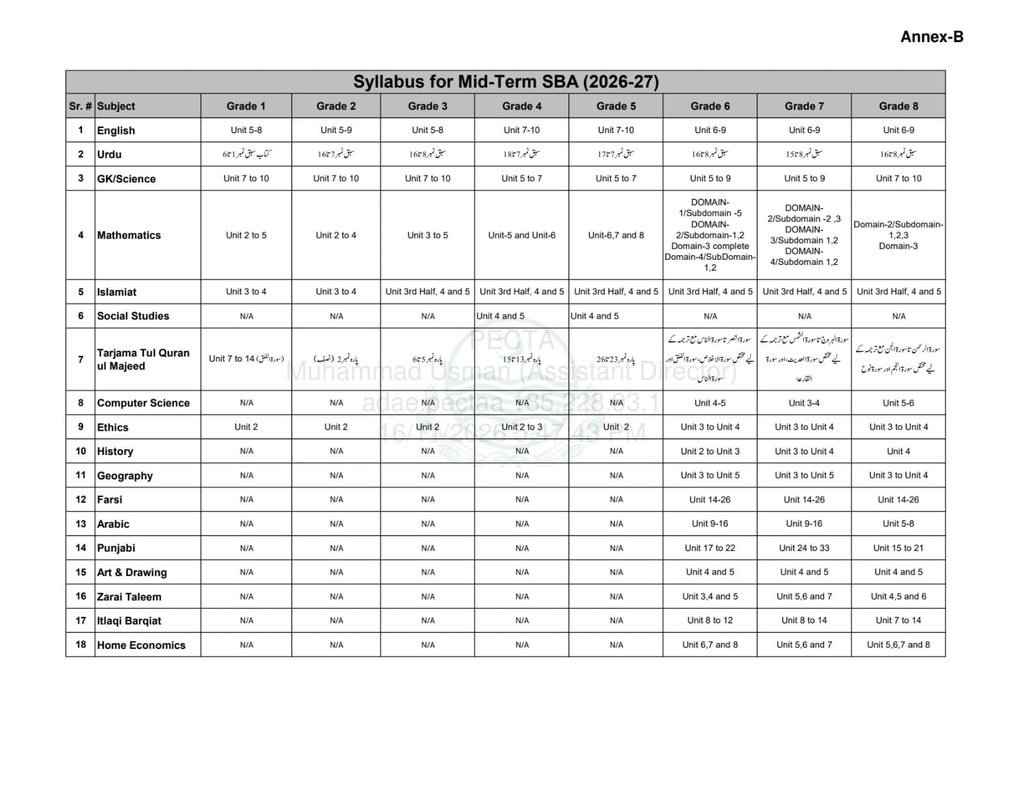
Syllabus for Mid-Term SBA 2026-27 — Annex-B
The syllabus is grade-wise and subject-wise, as per the Academic Calendar. The notification lists units for 18 subjects, including English, Urdu, General Knowledge/Science, Mathematics, Islamiat, Social Studies, Tarjama-tul-Quran-ul-Majeed, Computer Science, Ethics, History, Geography, Farsi, Arabic, Punjabi, Art & Drawing, Agriculture (Zarai Taleem), Itlaqi Barqiat, and Home Economics.
The core subjects follow this broad pattern:
| Grade | English | Urdu | Mathematics | Science / GK |
|---|---|---|---|---|
| Grade 1 | Units 5-8 | Units 7-10 | Units 2-5 | Units 3-4 |
| Grade 2 | Units 5-9 | Units 7-10 | Units 2-4 | Units 2-4 |
| Grade 3 | Units 5-8 | Units 2-4 | Units 5-7 | Units 5-7 |
| Grade 4 | Units 7-10 | Units 5-9 | Units 5-9 | Units 7-10 |
| Grade 5 | Units 7-10 | Units 5-9 | Units 7-10 | Units 7-10 |
| Grade 6 | Units 6-9 | Units 6-9 | Units 6-9 | Units 6-9 |
| Grade 7 | Units 6-9 | Units 6-9 | Units 6-9 | Units 6-9 |
| Grade 8 | Units 6-9 | Units 6-9 | Units 6-9 | Units 6-9 |
For other subjects, the units vary by grade — for sample, Islamiat, Social Studies, History, Geography, Computer Science and Tarjama-tul-Quran-ul-Majeed have separate unit ranges for Grades 6, 7 and 8 in Annex-B.
Important for teachers: Do not educate from guess papers or previous PEC patterns. The Mid-Term SBA 2026-27 is developed in accordance with the syllabus as per Academic Calendar, and the Item Bank on IBS will reflect Annex-B only. Verify the exact unit collection for your subject and grade from IBS after 1 December.
Paper Pattern for Mid-Term SBA 2026-27 — Annex-C
The paper pattern changes significantly after Grade 5. Grades 3-5 have a simpler, 50-mark paper. Grades 6-8 have a more detailed, skills-based paper.
Grades 3 to 5 — 50 Marks
| Grade | Subject | MCQs | MCQ Marks | ERQs | ERQ Marks | Total Marks |
|---|---|---|---|---|---|---|
| 3 | GK, Islamiat, Math, English, Urdu | 10 | 20 | 3 | 30 | 50 |
| 4 | Islamiat, Math, Science, SST, English, Urdu | 10 | 20 | 3* | 30 | 50 |
| 5 | Islamiat, Math, Science, SST, English, Urdu | 10 | 20 | 3* | 30 | 50 |
*For Grade 4 Science and Grade 5 SST, the notification lists 6 ERQs carrying 30 marks in total, still totalling 50 marks.
What this means: In Grades 3-5, MCQs are worth 20 marks and extended questions are worth 30 marks. Conceptual understanding and written expression carry more weight than ticking the right option.
Grades 6 to 8 — 40 or 50 Marks Depending on Subject
| Subject Group | MCQs | MCQ Marks | RRQs | RRQ Marks | ERQs | ERQ Marks | Total |
|---|---|---|---|---|---|---|---|
| Most subjects: Islamiat, History, Geography, Computer, Arabic, Farsi, Art, Agriculture, Home Economics, Itlaqi Barqiat | 16 | 16 | 6 | 12 | 2 | 12 | 40 |
| Mathematics & Science | 20 | 20 | 5 | 15 | 3 | 15 | 50 |
| English & Urdu | 20 | 20 | 5 | 10 | 2 | 20 | 50 |
| Tarjama-tul-Quran-ul-Majeed (TQM) | 5 | 5 | 5 | 10 | 2 | 10 | 25 |
What Students Should Practise
- MCQs: Factual recall and concept clarity — 1 mark each in most Grade 6-8 subjects, 2 marks each in Grades 3-5.
- RRQs (Restricted Response Questions): Short answers, usually 2-3 marks each. Author to the point, with the correct term and one line of explanation.
- ERQs (Extended Response Questions): Long answers, 6-10 marks each in Grades 6-8, 10 marks each in Grades 3-5. These test explanation, examples, and application — not copied definitions.
Date Sheet for Mid-Term SBA 2026-27 — Annex-D
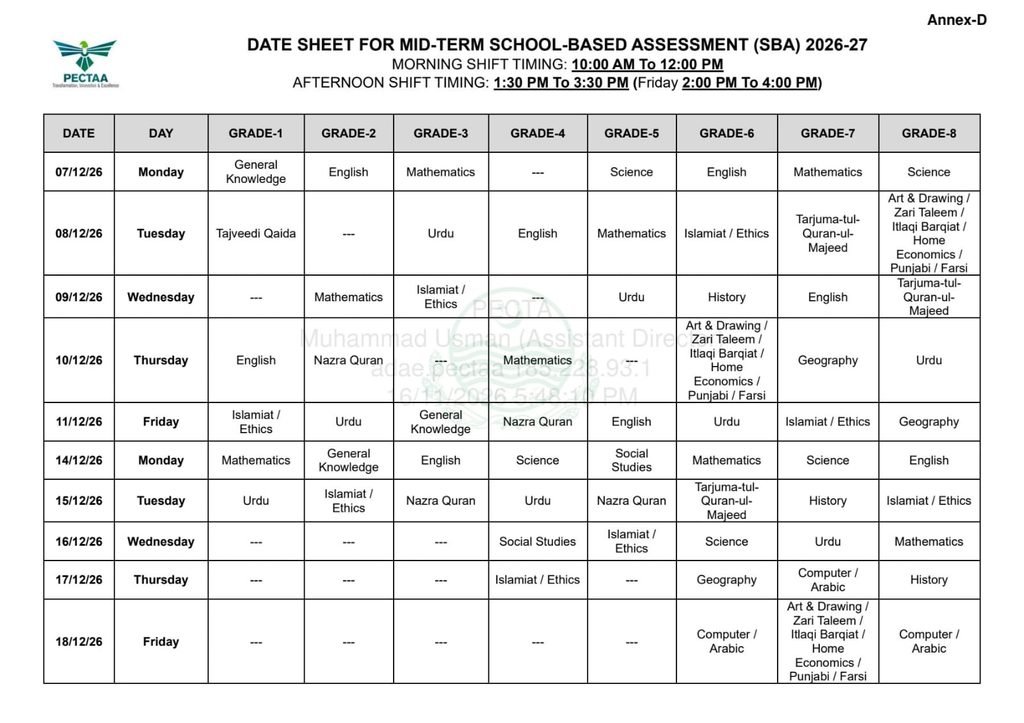
Exam Timings
- Morning Shift: 10:00 AM to 12:00 PM
- Afternoon Shift: 1:30 PM to 3:30 PM
- Friday Afternoon Shift: 2:00 PM to 4:00 PM
Day-Wise Date Sheet (7-18 December 2026)
The official date sheet is grade-wise, with diverse papers on the similar day for distinct grades. The outline is:
| Date | Day | Main Papers |
|---|---|---|
| 07 Dec 2026 | Monday | English, Mathematics, Science, General Knowledge, Art & Drawing / Agriculture / Tarjama-tul-Quran |
| 08 Dec 2026 | Tuesday | Urdu, English, Mathematics, Islamiat / Ethics, Home Economics / Punjabi / Farsi |
| 09 Dec 2026 | Wednesday | Mathematics, Urdu, History, English, Tarjama-tul-Quran / Islamiat |
| 10 Dec 2026 | Thursday | English, Nazra Quran, Mathematics, Geography, Urdu, Home Economics / Punjabi / Farsi |
| 11 Dec 2026 | Friday | Urdu, Nazra Quran, English, Urdu, Islamiat / Ethics, Geography, General Knowledge |
| 14 Dec 2026 | Monday | Mathematics, English, Science, Mathematics, Social Studies, General Knowledge |
| 15 Dec 2026 | Tuesday | Urdu, Nazra Quran, Urdu, History, Islamiat / Ethics, Tarjama-tul-Quran |
| 16 Dec 2026 | Wednesday | Social Studies, Science, Urdu, Mathematics, Islamiat / Ethics |
| 17 Dec 2026 | Thursday | Islamiat / Ethics, Geography, History, Computer |
| 18 Dec 2026 | Friday | Arabic, Computer, Art & Drawing / Agriculture / Home Economics / Punjabi / Farsi |
Note: This is a summary. The exact paper for your child’s grade on each date is given in Annex-D. Head teachers should display the grade-wise date sheet on the academy notice board and distribute it in the academy WhatsApp group before 7 December.
How Schools Generate Papers from IBS — Step-by-Step
- Log in to the Item Bank System (IBS) with the school login after 1 December 2026.
- Select grade, subject and medium (English or Urdu, where allowed).
- Generate the system paper. For Grades 3-8, it will be a one-page paper with QR code and EMIS details.
- Download the Keys & Rubrics generated along with the paper. These are essential for marking.
- Print the required number of copies. For Grades 1-2, print one coloured, two-page copy per subject for teachers only.
- Store papers and rubrics in secure custody until the exam day, and keep them after marking for validation.
- Do not share the IBS-generated paper on social media or WhatsApp before the exam. Leakage can lead to monitoring action.
Preparation Guide
For Students
- Revise only the units listed in Annex-B for your grade. Do not revise the whole book.
- For Grades 6-8, practise RRQs and ERQs in writing — not just reading. Duration yourself: 2 hours is enough for 40-50 marks if you draft clearly.
- For English and Urdu, practise listening, speaking and reading daily. In Grades 1-2, these skills are tested on the equivalent day as the written inquiry.
- Revise MCQs from the textbook exercises and key terms at the end of each unit.
For Teachers
- Plan cross-invigilation and cross-marking rosters before 7 December. No educator should invigilate or mark their own subject/class.
- Check IBS login, printer, and QR code printing on 1 December itself.
- Train all teachers on Keys & Rubrics. Marking without rubrics creates inconsistency and complaints.
- Update the Assessment Register daily during marking.
For Parents
- Do not panic concerning SBA. It is a mid-term, institution-based check, not a board consequence. Its purpose is to demonstrate where your child needs help before the final term.
- Help your child revise the listed units, ensure sleep and breakfast on exam days, and attend the PTM on the first working day after winter vacation to collect the report card and discuss it with the instructor.
- Exam season also means extra costs — stationery, transport, and revision material. Planning ahead with practical ways to manage household education costs can reduce last-minute stress, and a long-term savings plan for your children’s schooling is worth starting early, even with a compact monthly amount.
Comparison: Mid-Term SBA vs Traditional Annual Exams
| Feature | Mid-Term SBA 2026-27 | Traditional Annual Exam |
|---|---|---|
| Paper setter | PECTA Item Bank, generated by institution via IBS | School teacher or central board |
| Paper format | 1 page with QR code + EMIS (Grades 3-8) | Multi-page printed paper, no QR |
| Question types | MCQs + RRQs + ERQs (Grades 6-8) | Mostly long questions, few MCQs |
| Grades 1-2 | Oral + 1 written inquiry in English/Urdu | Often fully written |
| Invigilation | Cross invigilation mandatory | Often own subject instructor invigilates |
| Marking | Cross marking mandatory, with Keys & Rubrics | Often same educator marks own class |
| Result | Uploaded on portal, report card at PTM after vacation | Announced in academy, report card identical day |
| Purpose | Diagnostic — identify learning gaps mid-twelve months | Summative — final promotion decision |
The SBA setup is more standardised, more transparent, and harder to manipulate — however it also demands more discipline from schools in paper generation, invigilation and marking.
Common Mistakes Schools Must Avoid
- Generating papers late, on 6 December evening, and printing in a rush.
- Allowing a subject instructor to invigilate or mark their own class.
- Marking without the IBS Keys & Rubrics.
- Sharing the paper image before the exam.
- Not uploading the outcome on the portal before declaring it.
- Not maintaining the Assessment Register.
Any of these can be flagged by the monitoring teams constituted by PECTA.
FAQs — Mid-Term SBA 2026-27 Punjab
When will the Mid-Term SBA 2026-27 start in Punjab?
Exams will be held from 7 to 18 December 2026 for Grades 1 to 8, as per the PECTA notification dated 16 November 2026.
When will the Item Bank be available?
The Item Bank will be uploaded on IBS on 1 December 2026. Schools can generate papers from 1 to 6 December 2026.
How are papers generated for SBA?
Schools log in to IBS, select grade and subject, and generate a framework paper with a QR code showing institution information and EMIS code. Keys & Rubrics are generated with the paper.
What is the paper pattern for Grade 5?
Grade 5 papers are of 50 marks — 10 MCQs of 20 marks and 3 ERQs of 30 marks for Islamiat, Math, Science, Social Studies, English and Urdu.
What is the paper pattern for Grade 6, 7 and 8?
Most subjects are 40 marks (16 MCQs + 6 RRQs + 2 ERQs). Math and Science are 50 marks, English and Urdu are 50 marks, and Tarjama-tul-Quran is 25 marks.
How will Grade 1 and 2 be assessed?
Orally for all subjects, with five sections of 10 marks each. Only one query in English and one in Urdu will be written. Listening, speaking and reading will be tested on the same day.
When will the consequence and report cards be given?
Marking and report card preparation will run from 8 to 23 December 2026. Results will be uploaded on the portal on 28-31 December, and report cards will be shared at the Parent Teacher Meeting on the first working day after winter vacation.
What are the exam timings?
Morning shift: 10:00 AM to 12:00 PM. Afternoon shift: 1:30 PM to 3:30 PM, and on Friday 2:00 PM to 4:00 PM.
Can a instructor mark their own students’ papers?
No. Cross marking is mandatory. No educator can mark students they taught in the current academic session.
Conclusion
The Mid-Term SBA 2026-27 is a well-structured, transparent assessment — if schools follow the timeline and SOPs. The key is preparation in the first week of December: check IBS access, generate papers early, plan cross invigilation and cross marking, and display the date sheet clearly.
For students, the message is uncomplicated: revise the units in Annex-B, practise short and long answers in writing, and treat SBA as a chance to find and fix learning gaps before the final term — not as a fear. For parents, attending the PTM after winter vacation is as essential as the exam itself, as that is where the report card becomes a plan for the next term.
Schools that follow PECTA’s SOPs in letter and spirit will not only complete SBA smoothly, they will additionally supply parents and monitoring teams confidence in the result.
Analysis
Key takeaways:
- Timeline is tight however apparent: Only 6 days for paper generation (1-6 Dec) and 12 days for exams (7-18 Dec). Delay in IBS access is the biggest risk.
- Standardisation is the core change: QR-coded, one-page papers for Grades 3-8, bilingual option, and centrally generated Keys & Rubrics reduce variation between schools.
- Grades 1-2 are oral-earliest: The assessment correctly prioritises listening, speaking and reading over written testing at this age.
- Integrity controls are strict: Cross invigilation and cross marking are not suggestions — they are mandatory SOPs and will be monitored.
- Grades 6-8 are skills-based: The mix of MCQs, RRQs and ERQs rewards understanding and application, not rote memorisation.
- The effect process matters: Upload before declaration, keep papers for validation, and spread report cards at PTM — the assessment is incomplete without these steps.
Opinion
In my expert view, PECTA’s Mid-Term SBA 2026-27 is a step in the right direction for Punjab’s general schools — it brings standardisation without turning a mid-term test into a high-stakes board exam.
The strongest part is the integrity design: IBS-generated papers, QR codes, rubrics, and cross marking together produce it considerable harder to inflate marks or favour one’s own class. The weakest part is execution risk. Many schools, especially in rural areas, face printer, internet and IBS login issues in the initial days of December. If PECTA and DEAs do not deliver hands-on support during 1-6 December, the schedule will slip and teachers will be blamed for a system challenge.
My verdict: Schools should treat 1 December as Day 1, not as a date to check later. Generate one sample paper on the first day, test printing and QR scanning, and finalise invigilation and marking rosters in advance. Students who revise the notified units and practise writing answers — rather than only reading notes — will perform significantly improved, especially in Grades 6-8 where ERQs carry 12-20 marks.
SBA will only enhance learning if its consequence is used. The PTM after winter vacation should not be a formality for collecting a card. It should be a 5-minute conversation per child: what was strong, what was weak, and what will adjust in the next term.
About the Writer: Majid Farooq
Educationist & Web Tool DeveloperMajid Farooq is an experienced English educator, academic content specialist, and digital assessment developer holding M.A. English, M.Ed., and B.Ed. degrees. With over a decade of teaching and college lecturing experience, he specializes in creating SLO-based study resources, interactive educational web tools, and step-by-step official documentation guides for students, teachers, and professionals across Pakistan. Through FinSaves.com, he is dedicated to delivering accurate, verified, and easy-to-follow educational, health, and public-service guides that empower readers with practical knowledge. Whether breaking down complex board examinations, admission procedures, or regulatory portals, his work focuses on clarity, authenticity, and real-world utility.